“Spent four hours on the Acme job today, hourly.”“Ran a call at the Henderson place. Two hours, plus $87 for the breaker.”“Wrapped a two-day shoot at Apex Media. Plus $400 for the gear package.”“Strategy session with the Acme team. Hour and a half, hourly.”“Shipped the auth refactor for Acme today. Six hours, hourly.”“Saturday's wedding. $850 flat.”
Your first invoice. The one nobody taught you to send
You don't need an LLC. You don't need an accountant. You don't need the perfect template. You need to send the invoice. Written for anyone sending one for the first time.Written for the gig you wrapped and the invoice you've never sent.Written for the job you finished and the invoice you've never sent.Written for the session you ran and the invoice you've never sent.Written for the contract you shipped and the invoice you've never sent.Written for anyone who's never done this before. Yes, you.
Reassurance
Three things you don't actually need
An LLC.
Plenty of people on the internet will tell you that you need one. You don't. If you're invoicing as yourself, with your name on the invoice and your bank account taking the payment, you're a sole proprietor by default. The IRS treats your business income on Schedule C of your personal tax return. No formation paperwork, no annual filings, no LLC fees. An LLC has its uses. Liability separation between personal and business. A credibility signal to some clients. But none of those things are a prerequisite for getting paid. Form one later if and when you need it.
An accountant.
You don't need one for the first invoice. You don't need one for the tenth. What you do need is to set aside roughly 30% of every dollar you take in for taxes. Move it to a separate savings account the day the money clears. That habit covers most freelancers their first year or two. Hire an accountant when your work outgrows what fits in a spreadsheet. Not before.
The perfect template.
Spend an hour looking at invoice templates online and you'll come away thinking your invoice has to look like a corporate purchase order. It doesn't. An invoice is a piece of paper that says "pay me X for Y." That's the whole thing. A clean Google Doc clears the bar. A PDF made from a phone app clears the bar. You'll refine the look over time. Send the first one tonight.
The mechanics
What actually goes on an invoice
Seven things. That's it.
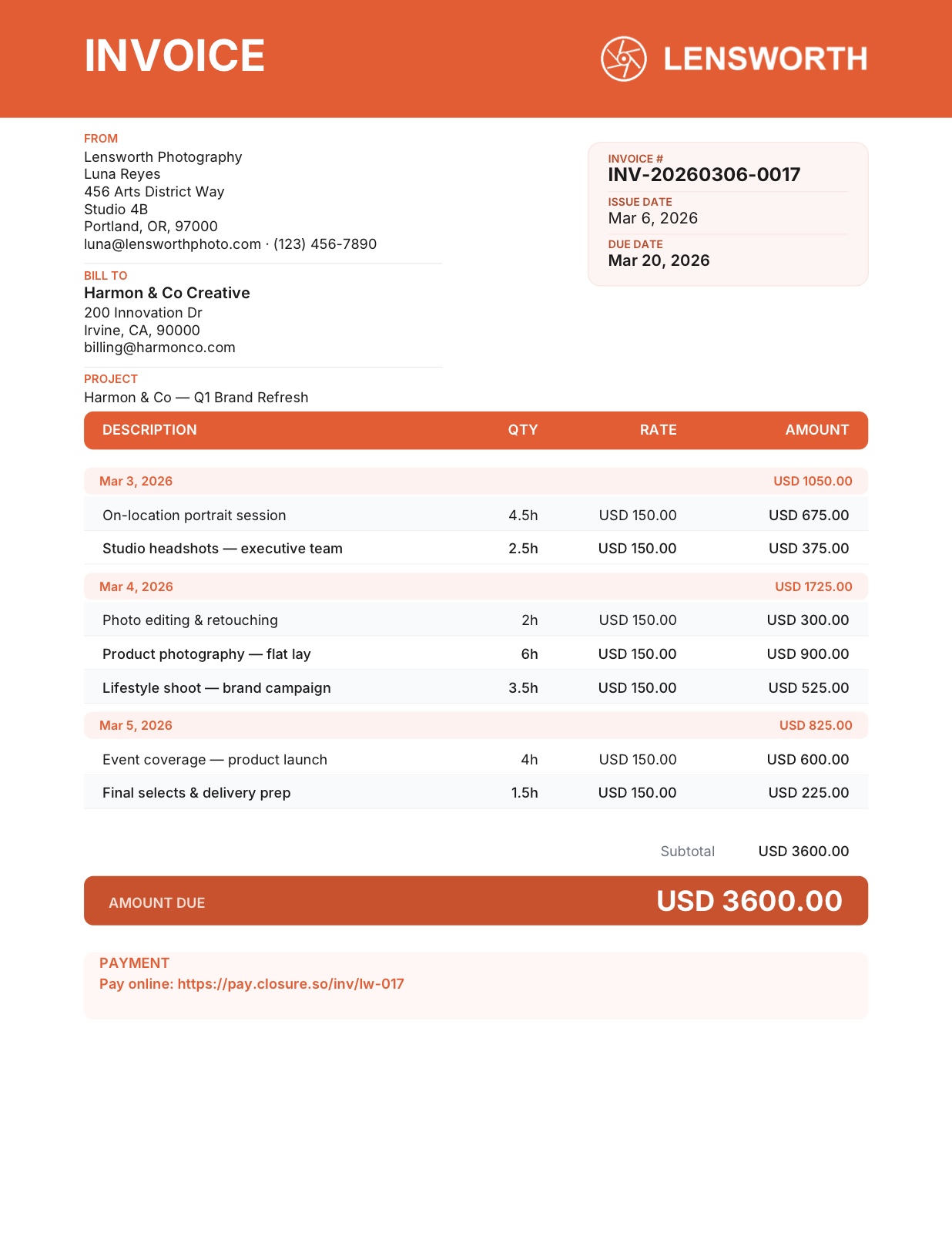
Your name and contact. Whatever you'd want a client to type onto a check. Email and phone if you have them.
Your client's name and contact. Person or company. The legal entity that's actually cutting the check, not just the person you've been talking to.
An invoice number. Pick something. 001 works for the first one. Sequential numbers from there.
A date and a due date. Date you're sending. Date you expect payment. Net 30 is the freelance default. Thirty days from the invoice date. Net 14 is fine if you ask for it.
What you did. Line items. One per thing. "Editing, half day, 4 hours, $400" beats "Misc. video work, $400."
The amount. Subtotal, any tax or discount, total. Bigger, clearer, lower-right.
How to pay you. Stripe link, ACH details, PayPal, Zelle, Venmo Business (not personal Venmo), check by mail. Pick one or two. Don't list five.
That's the whole thing. Anything else is decoration.
The negotiation
How much to charge
This is the part nobody warns you about.
The pricing argument isn't between you and the client. It's between you and the version of yourself who'd rather not have to ask for money. You picture what they can afford. You picture their reaction. You compare yourself to the freelancer down the street and assume they know something you don't. You quietly talk yourself down. Then you send a number that's lower than it should be and you don't know why.
What helps: a rough sense of what the market pays for the work you do. Not a number to charge. A band to fall inside.
Two things help. Look at job postings in your field and at Bureau of Labor Statistics rates for your category. Talk to two people who do this work, even on Reddit, even by DM. Triangulate to a band. Then round up, not down. Pick a number you can say out loud without flinching.
Service-call minimums and hourly rates vary by region and by trade. Look at what a staff version of your trade earns in your area to anchor a baseline. Then add a quarter to a half on top for working as your own boss. You're carrying fuel, insurance, parts mark-up, and overhead the shop used to absorb. Your bill rate isn't your wage rate.
Creative pay depends on your craft. Production work runs on day rates. Design and photography usually charge by the project. Editing tends to run hourly. Whatever model fits your work, look up what a staff version of your role earns in your market and add 25-30% for self-employment costs. That's the floor you're trying not to slip below.
Hourly rates compress what you're worth into a number that usually sells you short. If you can frame the work as a project or a monthly retainer instead, do that. For an anchor: take a staff salary for your specialty, divide by 1,000 (not 2,000). That accounts for unpaid hours. Round up.
Freelance engineering rates vary widely by specialty and experience. A senior W-2 salary divided by roughly 1,000 (not 2,000) gives you the self-employment-adjusted hourly. Retainer or fixed-bid work usually pays better than billed hours for the same work, and clients tend to prefer it. Quote in weeks or sprints when you can.
Whatever the work is, someone else is doing it for money. Find them. Look at how they charge: by the hour, by the job, by the session, by the package. Use that as a starting point, not a ceiling. Then add a little.
Most people undercharge their first year. Don't be most people.
The send
How to actually send it
Here's where most people get stuck. You know what the invoice needs to say. You know roughly what to charge. You sit down at the kitchen table at 11pm to write the thing. And then your brain goes blank.
This is the part Closure was built for.
You talk for a minute.
01
Hourly work
4 hr × $125
$500.00
01
Service call
2 hr × $145
$290.00
02
Materials · Breaker
Parts
$87.00
01
Production days
2 × $1,800
$3,600.00
02
Gear package
Add-on
$400.00
01
Strategy session
1.5 hr × $250
$375.00
01
Auth refactor
6 hr × $175
$1,050.00
01
Wedding photography
Flat fee
$850.00
Closure hears it and shapes it into a draft. Rates, dates, line items, ready for one tap. You review what it caught, fix what it missed, and send. The first invoice you send tonight isn't going to be the best one you ever send. It's going to be the one out the door.
Download on the App Store
Free for 14 days. iOS only.
The change
About the 2026 tax change
One thing the news cycle hasn't really caught onto: in 2026, the IRS rules changed.
Until last year, your client had to send you a Form 1099-NEC if they paid you $600 or more during the year. That triggered a paper trail. Starting January 1, 2026, the threshold jumped from $600 to $2,000. (It was tucked inside the One Big Beautiful Bill Act, signed into law last year.) Most freelancers won't see a Form 1099 for jobs under $2,000 anymore.
Worth being clear about what this changes and what it doesn't.
It doesn't change your tax bill. Every dollar of income is still taxable. The IRS still wants their cut.
It doesn't change what's on Schedule C. Self-employment income is self-employment income.
What it does change is the paper trail. The 1099 form used to be the safety net. A piece of paper that arrived in your mail and reminded you the income was there to report. With fewer forms going out, the safety net is now you and your records. Your invoice. Your bank deposit. Your work log. Keep them.
Practical takeaway: set aside roughly 30% of every dollar you take in for taxes. Higher if you're in a high-tax state. Move it to a separate savings account the day the money clears. Your future self in April will thank you.
(This page isn't tax advice. If your situation is unusual, talk to a CPA. Most situations aren't unusual.)
Full text of the change is in the IRS's 2026 information-return guidance.
A note from the founder
I'm Drew. I built Closure because the worst part of freelance work, for me, was the invoice.
I was a video producer. I'd finish a shoot, send the files over, and then nothing would happen for three weeks because I hadn't sent the bill. I knew how to do the actual work. The invoice part felt out of place. Like a clerical chore I was waiting for someone else to do.
If you're sitting down to send your first invoice tonight, I want to tell you two things. First, it doesn't get harder than this one. The second one is easier. The tenth is muscle memory. Second: the invoice is the easy part. The hard part was the work, and you already did it. Sending the bill is just closing the loop.
You're going to be fine.
Questions
Quick answers
Do I need an EIN to invoice?
No. If you're invoicing under your own name, your Social Security Number is what the IRS uses on your tax return. You can get an EIN free in five minutes from the IRS website if a client asks for one (some do, for their own records), but it isn't required to send invoices or get paid.
Can my client just Venmo me?
Yes, if they use Venmo for Business. Regular personal Venmo is against the platform's terms of service for commercial transactions, and the payment can be reversed or your account frozen. Zelle is similar. It's a bank-to-bank network, not a merchant product, and most banks limit it to personal use. Stripe, PayPal Business, ACH, or a paper check are cleaner. Put whichever you pick on the invoice.
How long should I give a client to pay?
Net 30 (thirty days from the invoice date) is the freelance default and what most clients expect. Net 14 is reasonable if you ask for it upfront, especially on smaller jobs. Net 7 is aggressive but not unheard of. Whatever you pick, write it on the invoice in plain language.
What if they don't pay?
Send a polite follow-up the day after the due date. Don't apologize for asking. A short note works: "Hi, just following up on invoice #001, originally due [date]. Could you confirm receipt and let me know when I can expect payment?" That clears most unpaid invoices. The ones it doesn't usually need a second nudge or a phone call. Closure drafts these for you and lets you send them in one tap.
Do I have to write "INVOICE" at the top?
Technically no. Practically yes. Putting "INVOICE" across the top in clear type tells your client's accounts-payable system what this document is, so it gets routed to whoever cuts checks instead of sitting in someone's inbox. The word matters less than the formatting, but the word doesn't hurt.
Will I get a 1099 for this work?
Maybe. Starting in 2026, your client only has to send you a 1099-NEC if they paid you $2,000 or more during the calendar year (up from $600). For smaller gigs, no form will arrive. Doesn't matter for your taxes. Every dollar is still reportable income. Save your invoices and bank statements either way.
Send it tonight
That's the whole thing. The work is done. The invoice is the part you've been worrying about.